
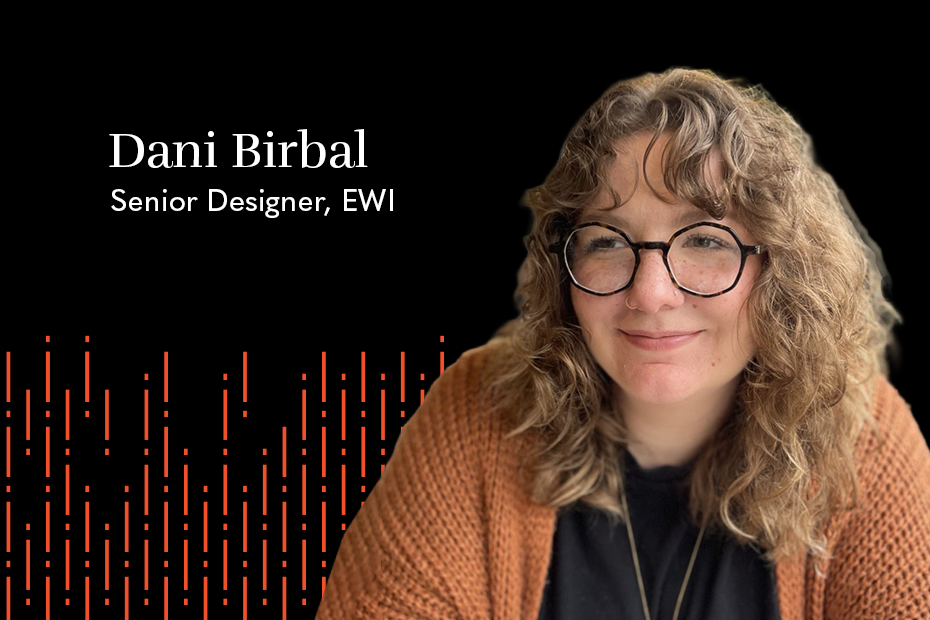
Employee spotlight: Dani Birbal
July 30, 2026
This month, we had an opportunity to catch up with Danielle Birbal, one of EWI’s talented senior designers. Dani’s work sits at the intersection of creativity, strategy and technical execution, turning client objectives into experiences that bring brands to life. During our conversation, we discussed her path to experiential design, the thinking behind great creative work and the teammates who help bring ambitious ideas across the finish line. We’re lucky to have Dani’s talent on our team.
Can you describe your role and responsibilities?
My role is actually a lot of roles packaged together. At the beginning of a project, I do a lot of concept design. I get to work directly with clients, listening to what they want to accomplish and then think through how that could come to life in two and three dimensions.
Every client needs something different. Some come to us with a clear idea, while others need help discovering what kind of experience they should create. In either case, I help guide the client toward a solution that meets the project’s objectives, works well and looks beautiful.
As a senior designer, I also help control the quality of our creative output. I’m a 2D designer and I work hand-in-hand with our 3D designers to turn concepts into designs that can be produced.
Then, when it’s time to get the work out the door, I can switch gears and work as a production designer. So I’m involved from the early vision through the technical details that make the finished experience possible.
How would you describe the difference between conceptual design and production design?
There’s a huge difference, even though both are essential.
Conceptual design is the creative and strategic part. Before deciding what something should look like, you have to understand the client’s objectives, the audience and the story you’re trying to tell. Then you think through how people will experience the physical space or digital engagement. That high-level thinking establishes the vision before detailed execution begins.
Production design is much more technical. You’re paying close attention to alignment, image resolution, exact dimensions and engineering drawings. You’re preparing files to be printed and cut correctly, and thinking about how materials will affect the final look and feel. Like, take fabric versus a hard panel, for example. They create completely different outcomes.
It’s important to know how to keep concepting and production work separate. If you’re trying to be pixel-perfect while concepting, you can limit the creative outcome. Once the vision is established, you can shift into production mode and execute every detail accurately.
How did you find your way to EWI?
I stumbled across EWI on LinkedIn. I mentioned the LinkedIn post to one of my professors at CCS, and he knew someone who worked at EWI, so he connected me with them. And that connection led to an interview.
I was drawn to experiential design because it combined so many things I enjoyed — thinking through user flow and engagement, working with physical spaces and bringing brands to life.
I didn’t get the job initially because another candidate had much more industry experience. Honestly, I understood the decision. I was still young in my career and had very little experiential work in my portfolio.
Then a few months later, EWI contacted me again, and I joined the team in late 2019. Right away, I contributed to projects for brands like T-Mobile and PUMA and worked with the retail team during ideation and concept development. It confirmed that experience design was where I wanted to be, and I wouldn’t change that for anything.
What is the biggest misconception people have about your job as a designer?
The biggest misconception is that designers just make things look good. Of course, aesthetics matter, but they come after a lot of thinking.
Every choice has intention behind it. We start with the client’s objectives and the story the brand needs to tell. Then we consider the audience, user flow, available technology, materials and production requirements. We have to determine how all of those pieces can work together so the message is easy for a consumer to understand and the experience feels cohesive.
In practice, that looks less like being a “stylist” and more like solving problems through a series of thoughtful creative decisions. Making the result look good is important, but it’s only one part of design.
What are you most proud of about working at EWI?
I’m proud to work alongside people who are passionate about what they do and deeply care about the outcome. They don’t want to just regurgitate what’s already been done — they always want to push boundaries and create the best possible outcome — both for ourselves and for the clients that we’re working with.
It feels good to be surrounded by teammates with that mindset. I know they have my back, just as I have theirs. I’m incredibly thankful for those people and for what we’re able to accomplish together.